
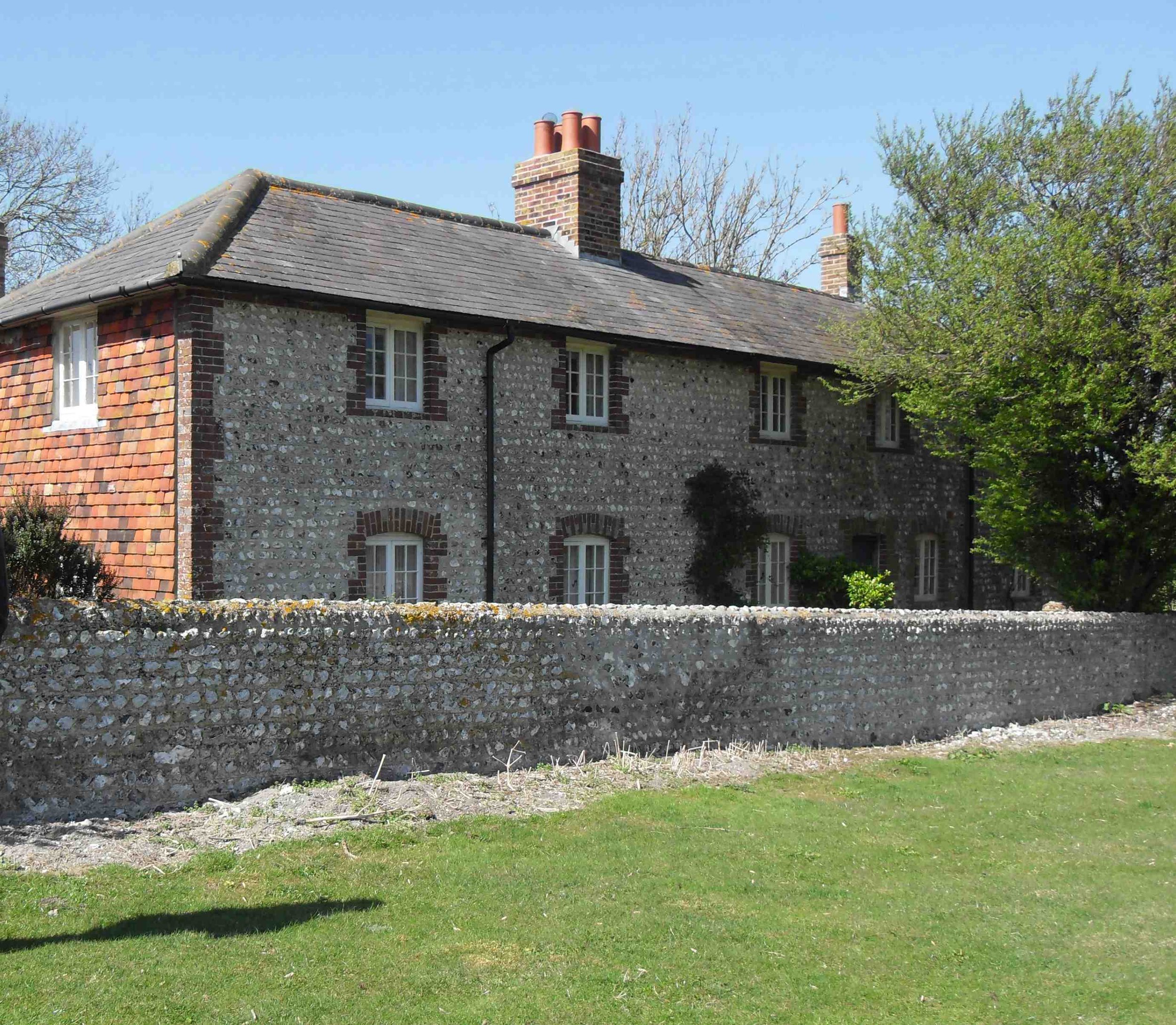
Furlongs photographed by me or Tim Mainstone, 2008
To fans of Eric Ravilious, Tirzah Garwood and their associated circle of artists, the name Furlongs is touched with magic. The house lies at the foot of Beddingham Hill, a mile or so from the Sussex village of West Firle. Carry on a couple of miles and you reach Charleston Farmhouse, country home of Vanessa Bell and Duncan Grant. Both houses were once attached to working farms and both became a haunt of artists and creative types of one kind and another, but whereas Charleston has been lovingly preserved for the public to enjoy, Furlongs is a private house that keeps its fascinating history to itself.
Artist and teacher Peggy Angus was looking for a cheap place to spend the summer when she came across the flint-faced brick cottage in 1933. At the time Furlongs was divided in two, and she persuaded tenant farmer Dick Freeman to let her half of the cottage for a peppercorn rent. The other half was occupied by the ploughman, Barnes, and his family - the ploughman’s daughter appears in the Ravilious watercolour Furlongs while Barnes himself can be seen at work in Mount Caburn.
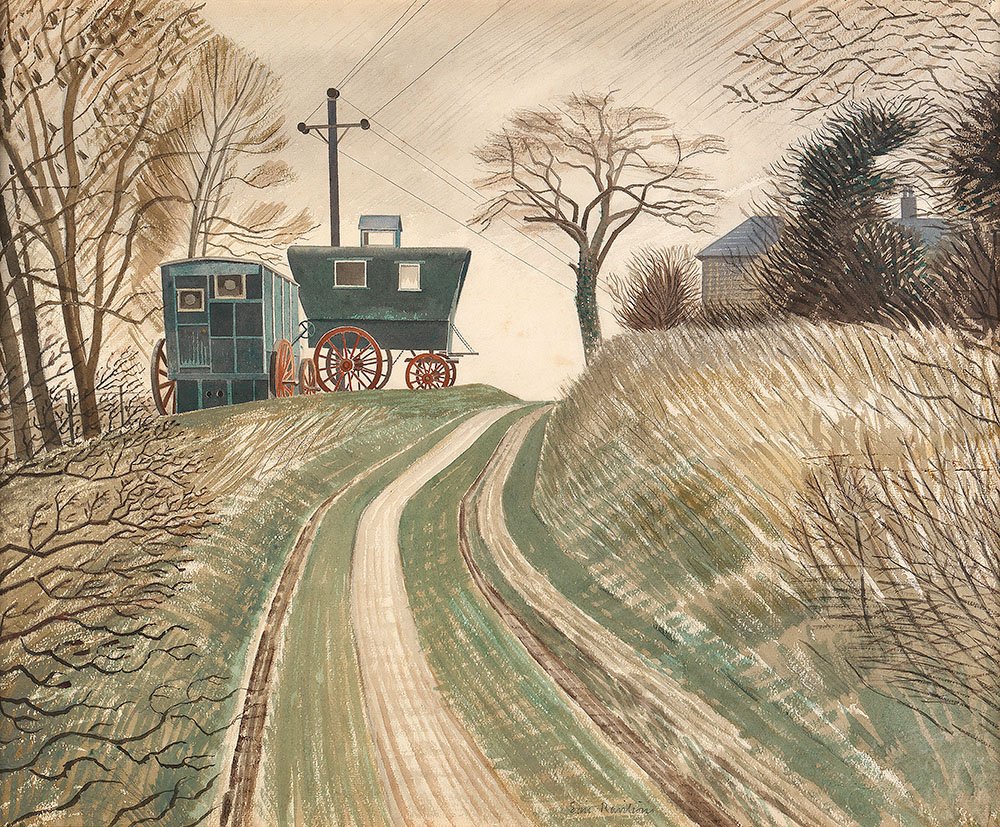
Eric Ravilious, Caravans, 1935
As you’d imagine, life at the cottage was basic, with coal fires and oil lamps for heat and light, a primus to cook on in the scullery shared with the neighbours, a well for water and an outdoor privy. There was some muttering on Facebook recently because a Ravilious watercolour shows telegraph poles in the lane, but whether they were bearing electricity or a phone connection they weren’t carrying either to Furlongs.
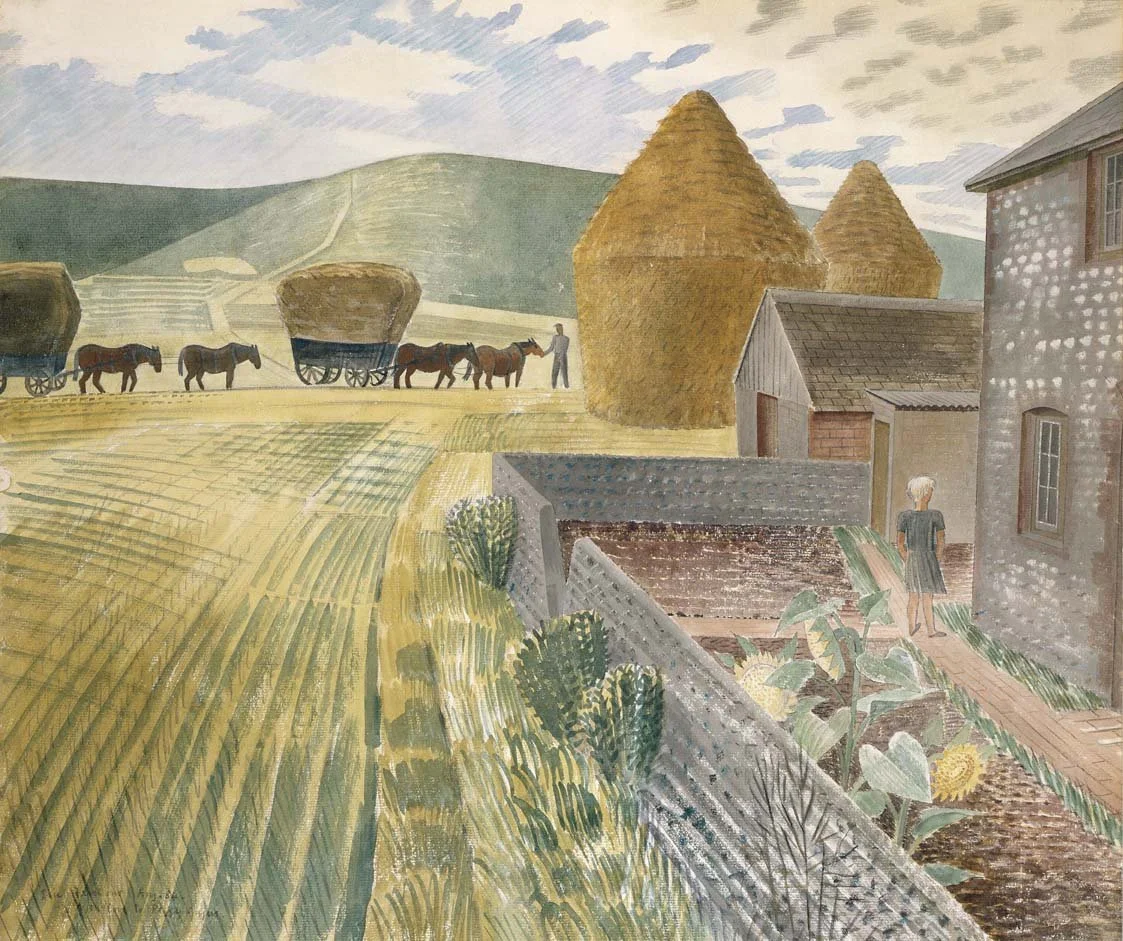
Eric Ravilious, Furlongs, 1934
(sadly this wasn’t available for the Ancient Landscape show - note sunflowers in foreground, for Van Gogh)
Angus was a gregarious sort and among the friends she invited to stay were fellow Royal College of Art graduate Eric Ravilious and his wife and fellow artist Tirzah Garwood. This invitation would prove life-changing for both Garwood and Ravilious and in more ways than one. It was at Furlongs that Ravilious had his well-documented affair with Helen Binyon, who was also an artist and coincidentally (or not) daughter of poet and art historian Laurence Binyon, a leading expert in the British watercolour tradition and also, intriguingly, in Asian art. Garwood and Ravilious almost split up but didn’t, and in the end Tirzah became lifelong friends with both Peggy and Helen. The latter’s memoir about Ravilious is a must-read.
The year Peggy first rented Furlongs, Laurence Binyon wrote his seminal book English Water-Colours, which championed artists of the past such as Paul Sandby, Francis Towne and John Sell Cotman and highlighted the contemporary work of their successors, notably John and Paul Nash - two artists Ravilious greatly admired. To the second edition in 1944 Binyon appended the names of Edward Bawden and Eric Ravilious who, he wrote, had developed ‘a new method of painting in water-colours of great delicacy and definition, using a technique of under-painting and elaborate super-imposed washes and stipples’.
Visitors to the exhibition Ancient Landscape, Modern Times at the Holburne Museum can admire this method in works such as The Wilmington Giant and Beachy Head. They may well also notice a quality of Ravilious’s watercolours that Binyon didn’t mention: their design. It’s this as much as the aforementioned technique that makes his work have such a powerful and lasting impression, and it was at Furlongs in the mid-1930s that he began to develop this aspect of his art
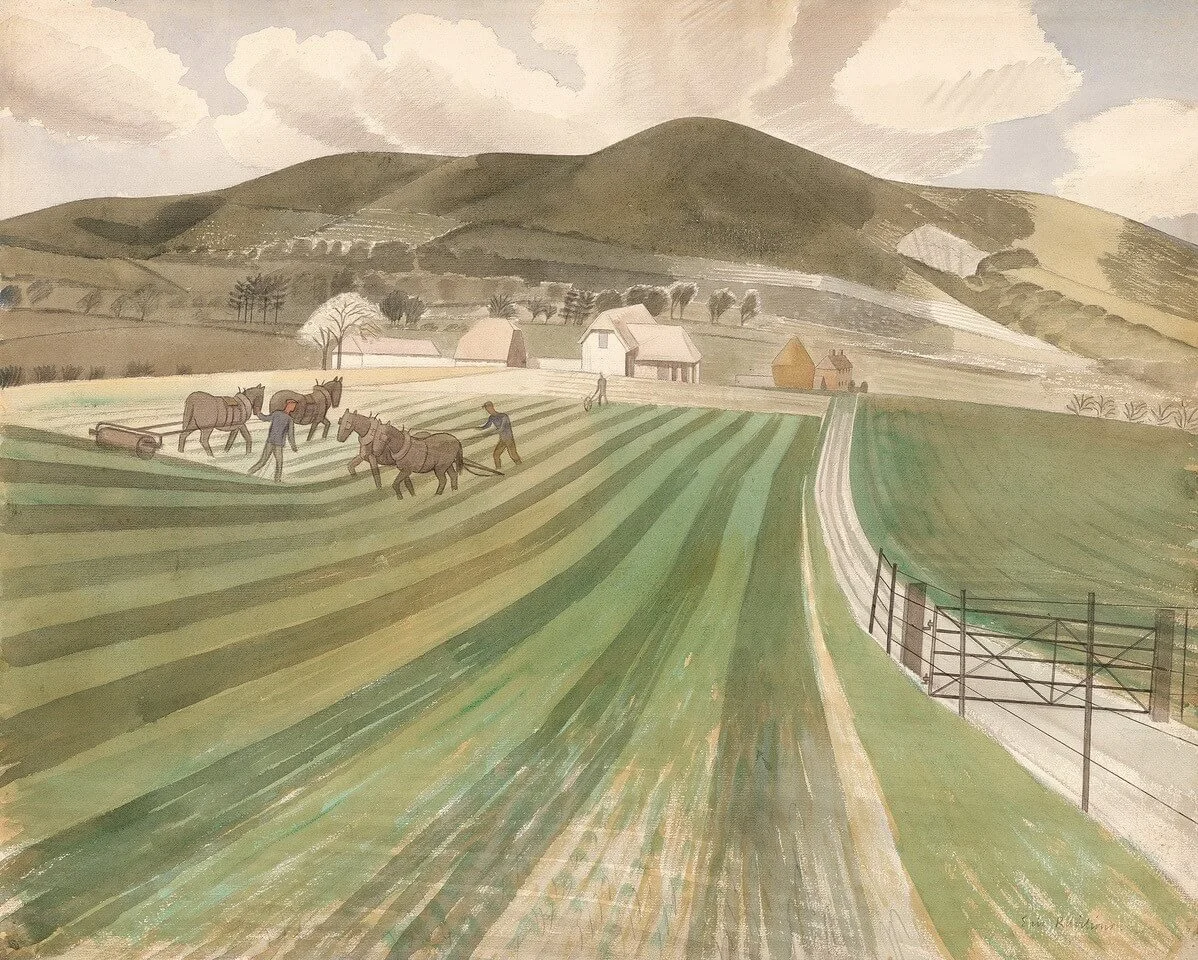
Eric Ravilious, Mount Caburn, 1934 (Furlongs is next to the haystack)
You can see this clearly by comparing two watercolours created a year apart. Though light and spacious, Mount Caburn is essentially a topographical drawing tinted with watercolour; stand where Ravilious stood and you’ll see pretty much what he drew. Look then at Chalk Paths. Over the years people have made all sorts of guesses about the place this watercolour depicts. In fact it’s based on the view along the path near the top of Beddingham Hill, but what we see is not what is actually there but an imaginative composition. The white paths and black barbed-wire fence lead our eye so decisively across the landscape of dark and light planes because they were designed to do exactly that.
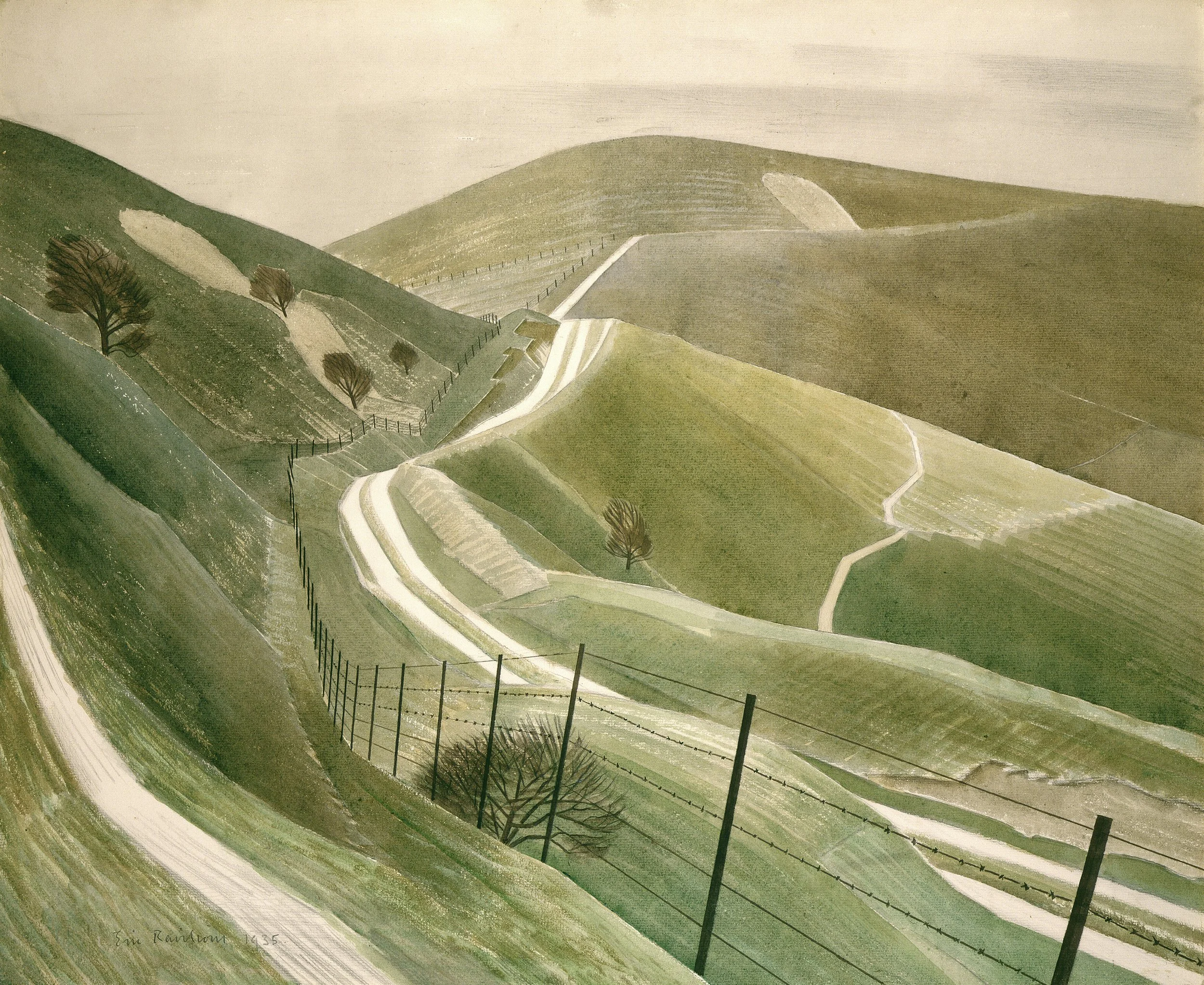
Eric Ravilious, Chalk Paths, 1935
If you go to the Ancient Landscape exhibition you can compare these two watercolours for yourself. Also hanging in Bath currently are Caravans, which shows a pair of antique wagons repurposed by Eric and Tirzah as accommodation (note the telegraph poles mentioned above), and Interior at Furlongs. I’ve been looking at this magical picture for twenty years and every now and again I still find something new in it, and while I have to save some discoveries for the book I’m writing I think you can see, for instance, the debt to Van Gogh in the sloping floor and larger-than-life chair.
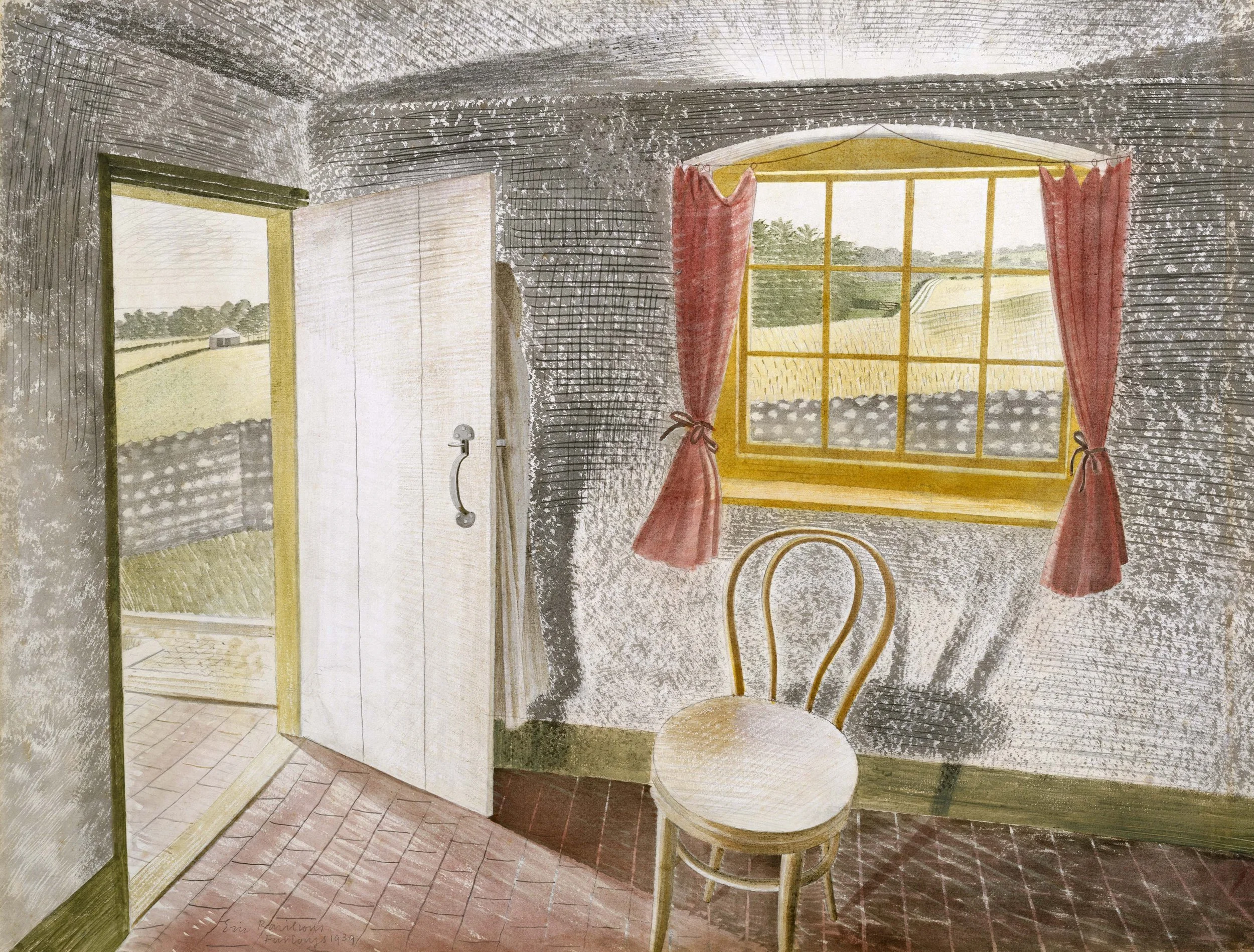
Eric Ravilious, Interior at Furlongs, 1939
Again this is not ‘a view of a cottage interior’ but an imagined space conjured on the paper by this extraordinary artist. On which subject, the Furlongs wall at the Holburne also features perhaps my favourite painting, Tirzah Garwood’s Etna. This is also based on the view of Mount Caburn from Furlongs, but is otherwise nothing like a Ravilious watercolour. Garwood had her own magic, and it was at Furlongs (and probably at Peggy Angus’s instigation) that she really began to cast spells. But we’ll come back to this…