
Paul Nash & the Hill of Dreams
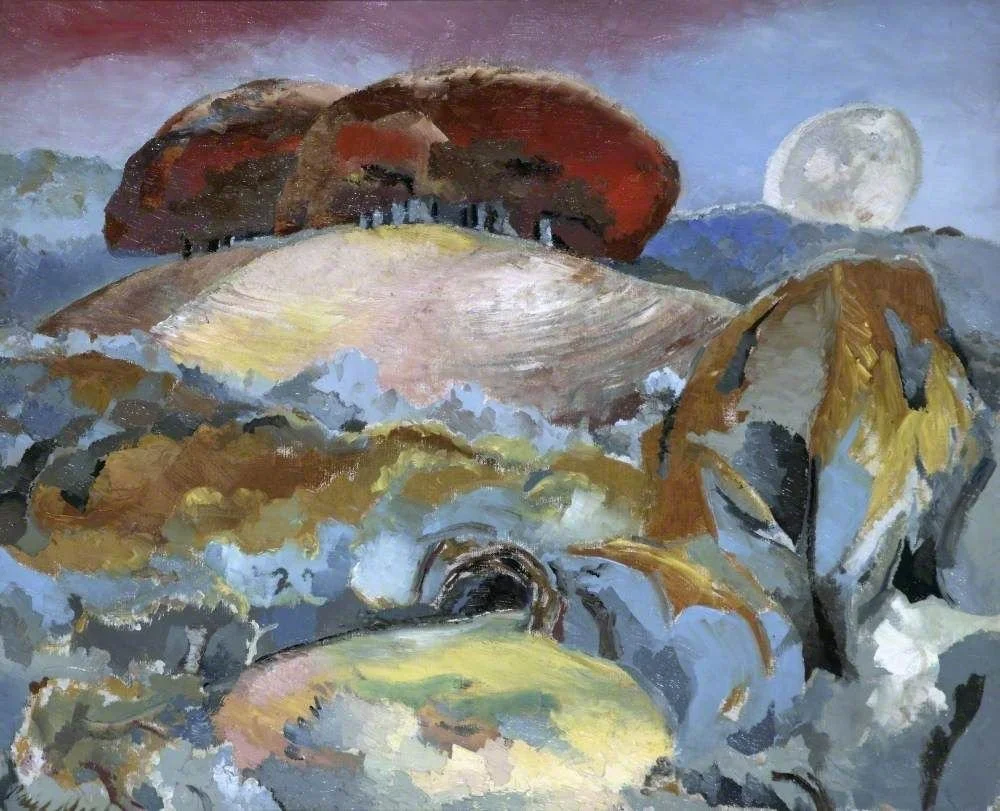
Paul Nash, Landscape of the Moon’s Last Phase, 1944, oil on canvas
‘Very full blown and frightening’ were the words Paul Nash used to describe the painting above, one of the last he completed and among his most powerful. But why did he say that? What was it about this work that alarmed him?
The painting is an imaginative composition based on a view over the Thames Valley from Boars Hill. Nash often travelled the short distance from his wartime home in Oxford to his friend Hilda Harrisson’s house, where a wide window framed this view over woodland to the distant tree-topped hills known as the Wittenham Clumps. The distinctive pair of hills - chalky outcrops of the Chilterns - had been a feature of Nash’s life for as long as he could remember, since his father’s cousin farmed the neighbouring land and they visited from time to time.
The Clumps also loomed large in his emergence as an artist with a fascination for place, or the spirit of place. As a young man Nash wanted to be an artist-poet like his hero Dante Gabriel Rossetti, and his influences were as much literary as artistic. Both he and his brother John loved George Borrow’s novel Lavengro, whose narrator roams the lanes of rural England. Nash also immersed himself in The Hill of Dreams, a 1907 novel by the mystical Welsh writer Arthur Machen in which the protagonist becomes fascinated by a hill fort overlooking his village; private and fenced, its attraction is irresistible.
‘One afternoon as he gazed from his station by the gate the sheer sides and the swelling bulwarks were more than ever things of enchantment; the green oak ring stood out against he sky as still and bright as in a picture, and Lucian, in spite of his respect for the law of trespass, slid over the gate…’
On climbing the hill and the earth walls of the fort he discovers a place at once ancient, secret and alive. Within are many of Nash’s future subjects, from ‘stones white with the leprosy of age’ and ‘an abominable fungus’ to trees twisted into grotesque forms. In this charged space Lucian experiences strange visions and a fantasy-fuelled erotic awakening. Four years after the book came out Nash described the Wittenham Clumps to his friend Mercia Oakley as:
‘Grey hollowed hills crowned by old, old trees, Pan-ish places down by the river wonderful to think on, full of strange enchantment… a beautiful legendary country haunted by old gods long forgotten.’
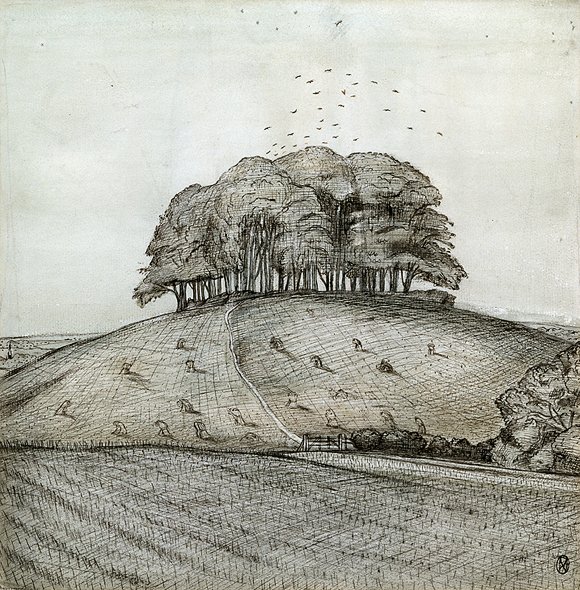
Paul Nash, The Wood on the Hill, 1912, ink & wash on paper
When he came to draw the Clumps the following year he focused on a single hill and presented it fenced and gated, with a path tempting the wanderer to discover ‘strange enchantment’ for themselves.
I think for Nash part of this enchantment lay in the association of these ancient hills with death and burial; there are grave sites from different periods on both hills and the remains of an Iron Age hillfort on Castle Hill (Nash’s drawing shows Round Hill). This partly explains why he referred to the Clumps as ‘the pyramids of my small world’. At the time he was coming to terms with the death of his mother in 1910 after a long and harrowing illness, and my feeling is that all these associations became bound up together in this place.
Fast forward thirty years. When Nash began visiting Hilda Harrisson he was dying from the effects of chronic asthma and knew it. Again this is my instinctual interpretation of the work, but I can’t help thinking that when he looked across at the Clumps from Boars Hill he experienced again those youthful feelings and thoughts. Using binoculars he was able to bring the twin hills closer, and closer, and closer still. Like Birnam creeping impossibly towards Dunsinane the Clumps grew ever nearer, until in Landscape of the Moon’s Last Phase they are massively present. A tunnel below leads… where? I think Nash knew.
Some of this post is based on a section of my book Paul Nash in Pictures: Landscape and Dream (Mainstone Press 2011). Both of the works shown feature in my forthcoming exhibition Ancient Landscapes, Modern Times, which opens at the Holburne Museum, Bath, in October 2026.