
The Vale of the White Horse
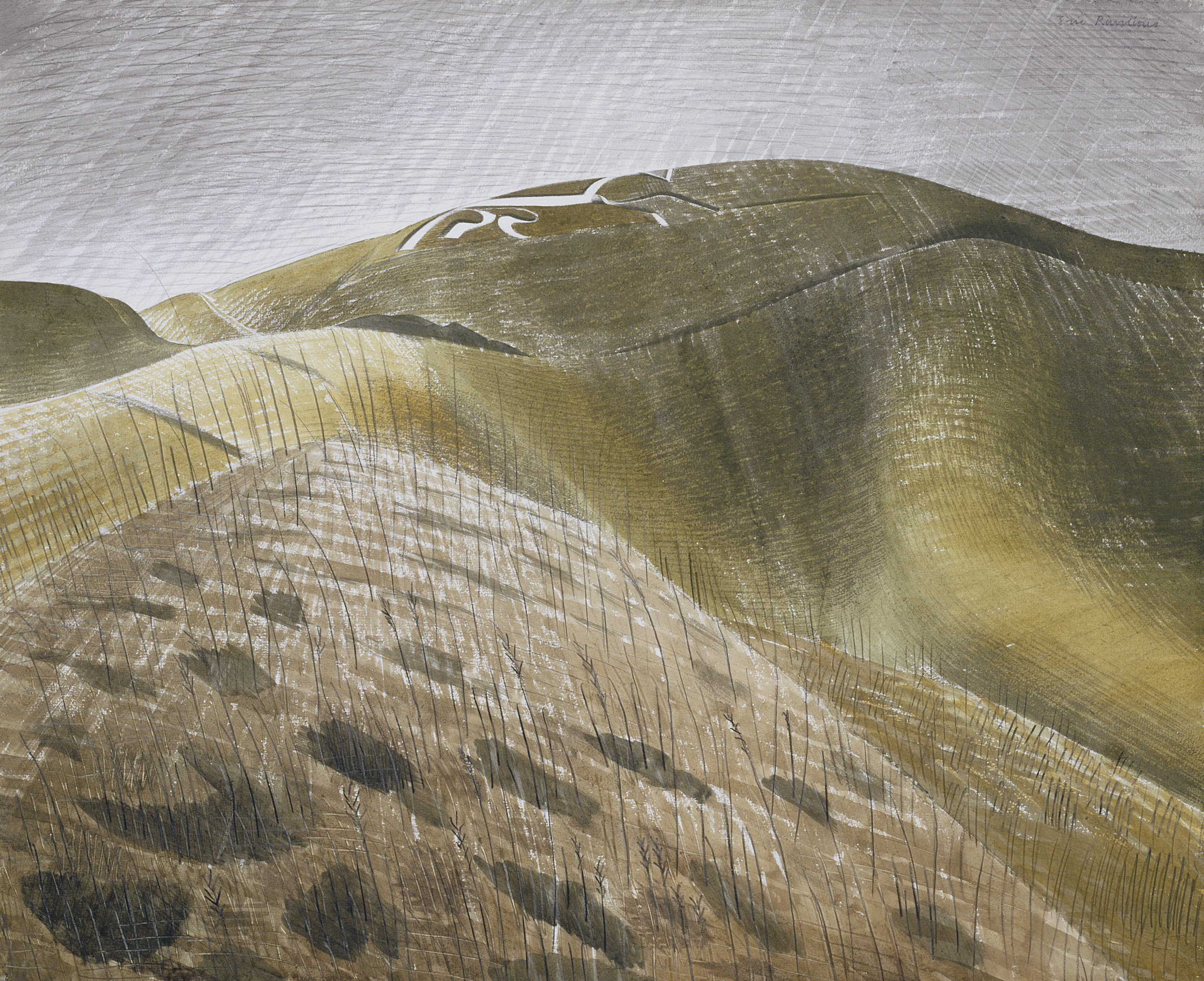
Eric Ravilious, Vale of the White Horse, 1939, watercolour
In December 1939, shortly before his appointment as an official war artist, Eric Ravilious travelled to the village of Uffington, just north of the Berkshire Downs. Walking up to the iron age hill fort on the ridge with his drawing board in a canvas satchel, he found a vantage spot looking across the steep valley known as The Manger to the White Horse. Completed back home in Essex, the resulting watercolour gives a vivid sense of place and atmosphere. Rain falls from a pale grey sky over chalky grassland that is rough and tufty in the foreground but becomes, at a distance, smooth and sinuous, almost muscular.
Cut into the hilltop, the horse itself is immediately recognisable, but you can’t see the figure in its entirety from the vantage point he has chosen. Ravilious most likely studied an aerial photograph, probably one reproduced on a postcard. He was an avid collector and sender of postcards.
The closer we look, the more clearly we can appreciate that this is not a topographical watercolour of the 18th-century school but a modern painting that takes an ancient motif and turns it into something thrillingly new. But why, we might ask, was Ravilious painting watercolours on the ramparts of an iron age hill fort as Britain braced itself for violent confrontation with Nazi Germany? The short answer is that he had been asked to paint watercolours of chalk hill figures and iron age monuments in preparation for a new children’s book on the subject.
But when you ask why the book had been proposed at all, and to Ravilious in particular, a much more interesting story begins to emerge. It features a group of artists, connected in a variety of ways, who explored the chalk hills on a quest to remake the tradition of landscape painting for the modern age. They did so against a backdrop of rapid modernisation in life and in art, and in the context of fevered national enthusiasm for the mysteries of the deep past…
This is the opening of my essay in the forthcoming book Ancient Landscapes, Modern Times: Eric Ravilious and the Artists of the Chalk Downs, which is being published to accompany the exhibition of the same name at the Holburne Museum, Bath. For more information please visit the museum’s website.
To read more of the essay you’ll have to buy the book!!