
Whistler’s Nocturnes on Trial
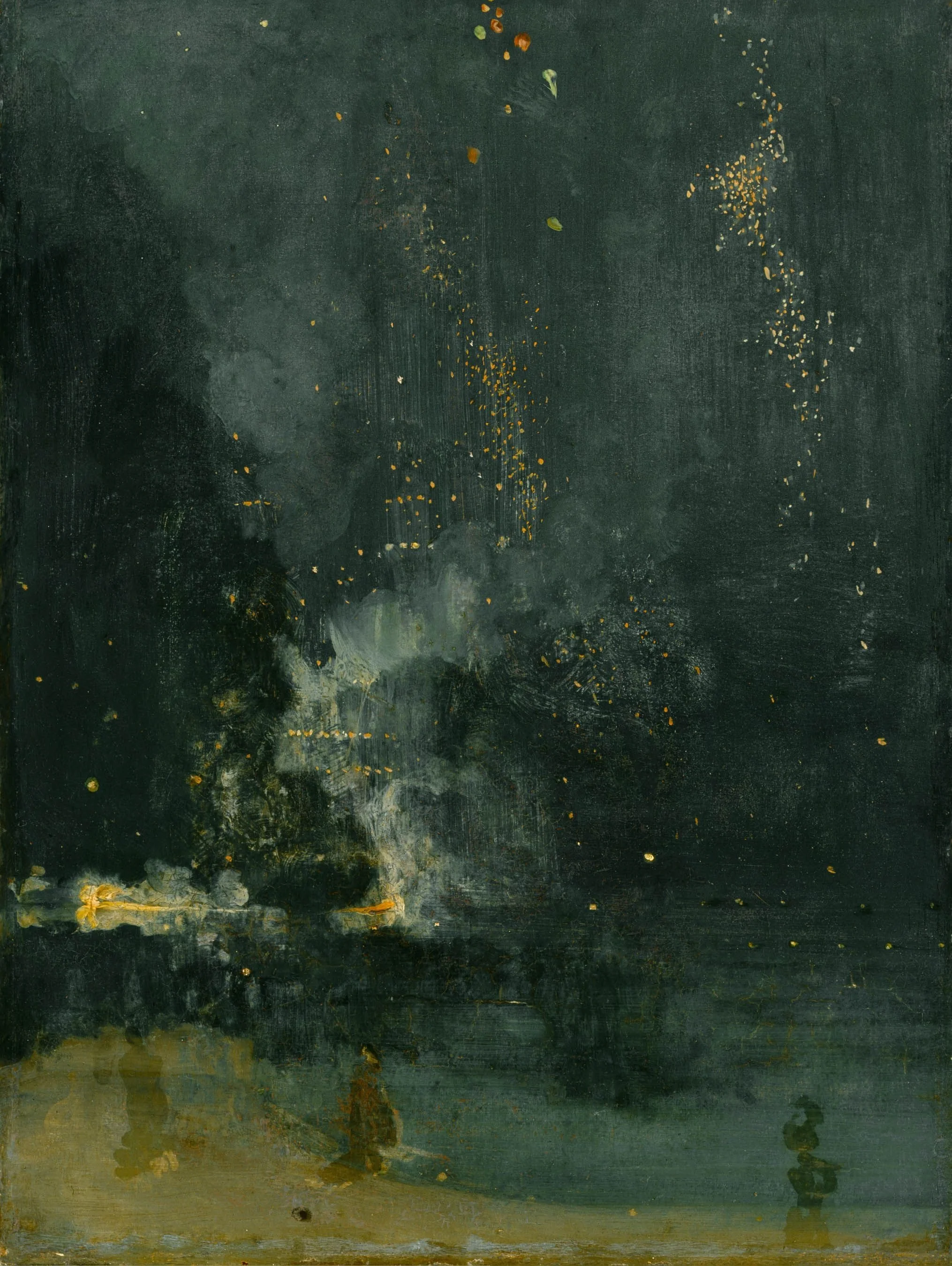
JM Whistler, Nocturne in Black and Gold: The Falling Rocket, 1875
The year 1877 saw some notable events in London – the first Test cricket match between England and Australia, the first Wimbledon tennis championship, the first human cannonball act – but in the London art world the exciting news was the opening of the new Grosvenor Gallery by artist and collector Sir Lindsey Coutts. The role and impact of this venture was described for the Royal Cornwall Gazette by ‘a Cornishman’ who visited in June.
‘Its locale is New Bond St (a five minute walk from the RA), in which art of the present and of ‘the future’ have taken up their home. Here almost every other door is an art gallery. The rejected and the rejectors of the Academy alike find refuge in this Bohemia of art… Some of the Wagners of painting – the creators of the ‘art of the future’ – are so far beyond the comprehension of the Hanging Committee that it is useless to send their pictures to the Academy unless they aspire to be elevated to a position near the ceiling…’
While the Academy still held sway officially, it was the Grosvenor that was ‘the particular rage just now… The architecture is peculiar – the work of an architect of the future probably, and the decorations are somewhat outre and extravagant, but the principal gallery is a noble room…
‘Shrubs and costly hothouse plants line the staircase and corridors, rare old China is scattered about the tables, and the restaurant is perfection. Hence it has become the fashionable lounge, and hither the jeunesse dori resort for their ‘afternoon crawl’. As for the pictures, ‘The general impression is confusing, bewildering. The Pre-Raphaelites are in force. There is gorgeous colouring, exquisitely fine manipulation and a wonderful fidelity to nature in the multiplicity of detail, every leaf and flower and spray and grass-blade being painted with scrupulous labour; but it has all a very distressing effect upon the eye of the ‘untutored savage’, and I could not help wondering where on earth the artists managed to ferret out such tangled scenes.
‘But the most marvellous productions are those of Mr Whistler – the veritable Wagner of art. Some people, I am told, consider Mr Whistler’s painting clever; I rejoice greatly that I am not a Whistlerite. He exhibits seven indescribable smudges, bearing the fantastic titles of Harmony in Amber and Black, Arrangement in Black, Nocturne in Black, etc, and consisting, apparently, of alternate daubs of the blacklead-brush and the blue-bag – evidently painted by the domestic Mary Jane during her recreative moments in the back kitchen. It has been surmised that Mr Whistler meant the whole thing as a huge joke…’
This was evidently the attitude taken by Mr Ruskin, who reviewed the exhibition in his journal Fors Clavigera. First he told his readers what they ought to find admirable in the exhibition, and then he came to Mr Whistler, and his Nocturne in Black and Gold: the Falling Rocket.
‘For Mr Whistler’s own sake,’ he rumbled, ‘no less than for the protection of the purchaser, Sir Coutts ought not to have admitted works into the gallery in which the ill-educated conceit of the artist so nearly approached the aspect of wilful imposture. I have seen, and heard, much of Cockney impudence before now; but never expected to hear a coxcomb ask two hundred guineas for flinging a pot of paint in the public’s face.’
On reading his review, Whistler sued for libel. For a year nothing happened. Provincial newspapers reported that he had dropped the case, but nothing could have been further from the truth. On 26 November 1878 the trial opened at the Court of Exchequer in Westminster, with Sir John Walter Huddleston presiding. Ruskin himself was mentally unfit to take part, but Whistler did appear as a witness. Arguing his case was Mr Serjeant Parry, while the Attorney General Sir John Holker took Ruskin’s side. and, in effect, controlled proceedings. Reading the lengthy transcripts that appeared all over the British and American press, it is clear the Parry took little pleasure in his work, whereas Sir John enjoyed himself tremendously throughout. And not surprisingly, since he had all the laughs.
Parry’s feeble opening statement praised Ruskin and offered some positive remarks about Whistler, before noting that ‘it was generally known that Mr Whistler had held a somewhat independent position, and he would place that gentleman in the box who would state some of his theories as to producing the greatest effect from colours. These might be eccentricities, but because a man had created a theory of his own, and followed out that theory almost with enthusiasm, he was not to be libelled.’
Not a great start. The artist himself then took the stand, and at Parry’s request defined a Nocturne, explaining that he intended to suggest a purely artistic interest in the work. ‘It is an arrangement of line, form, and colour first; and I make use of any incident of it which shall bring about a symmetrical result. Among my works are some night pieces; and I have chosen the word nocturne because it generalises and simplifies the whole set of them.’
You couldn’t really ask for a more straightforward explanation of the modern painter’s approach, but then came cross-examination by the Attorney-General. At his request Whistler explained that the painting represented fireworks at Cremorne, to which John quickly retorted, ‘Not a view of Cremorne?’
‘If it were called a view of Cremorne,’ replied the artist patiently, ‘it would certainly bring about nothing but disappointment on the part of the beholders.’
This got a laugh, as did Sir John’s response: ‘You do not think any member of the public would go to Cremorne because he saw your picture?’
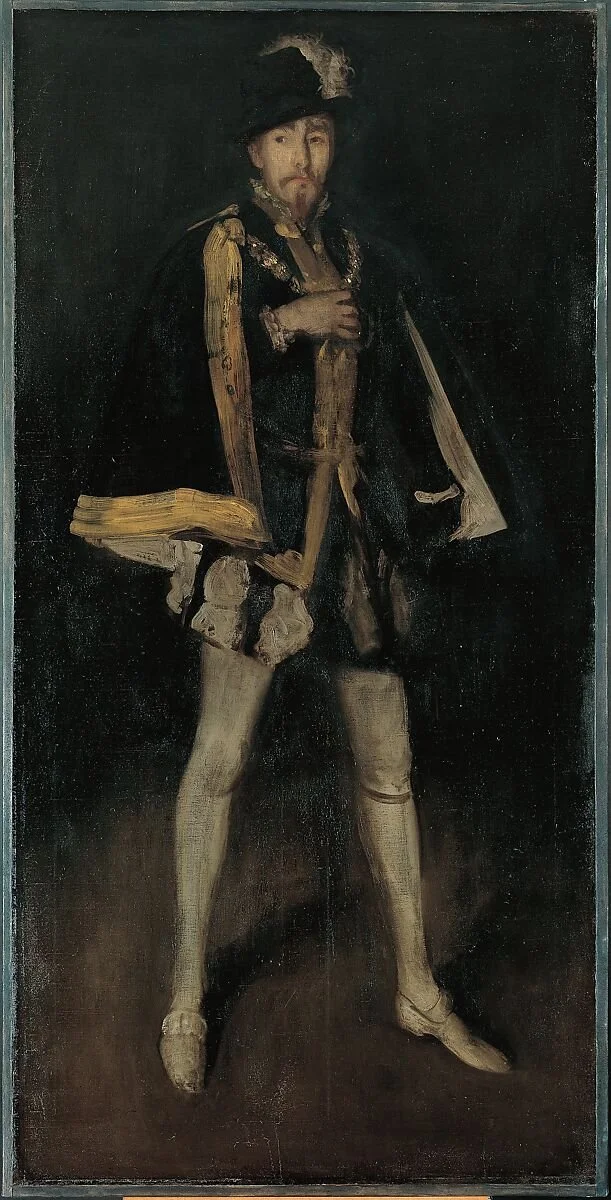
JM Whistler, An Arrangement in Black, Mr Irving as Philip II, 1876
‘I do not know how to describe the picture,’ responded Whistler. ‘It is simply an arrangement of colour.’ Continuing as best he could to explain his work to the packed courthouse the artist described some other paintings, coming eventually to The Arrangement in Black: Mr Irving as Philip II.
‘Why do you call Mr Irving an Arrangement in black?’ asked the Attorney-General.
‘It is the picture and not Mr Irving who is the arrangement,’ cut in the judge, to the delight of the crowd.
‘What was the Arrangement in amber and black?’ continued Sir John, and at this Whistler again tried to regain control of the situation, explaining carefully that these arrangements were his own impressions – his particular area of study.
‘I suppose you are willing to admit that your pictures exhibit some eccentricities, queried Sir John; you have been told that over and over again?’
‘Yes, very often.’
‘You sent them to the Gallery to invite the admiration of the public?’
‘That would be such vast absurdity on my part that I don’t think I could.’
The small court room, packed to bursting with curious members of the public, was by this time on the verge of hysteria. Whistler did love an opportunity to show off, but so too do counsel and even judges, and for them the fun was only just beginning. After a deal of wrangling about whether or not it was fair to bring a painting into the poorly-lit courtroom, Nocturne in Blue and Silver: Battersea Bridge was brought ceremoniously in.
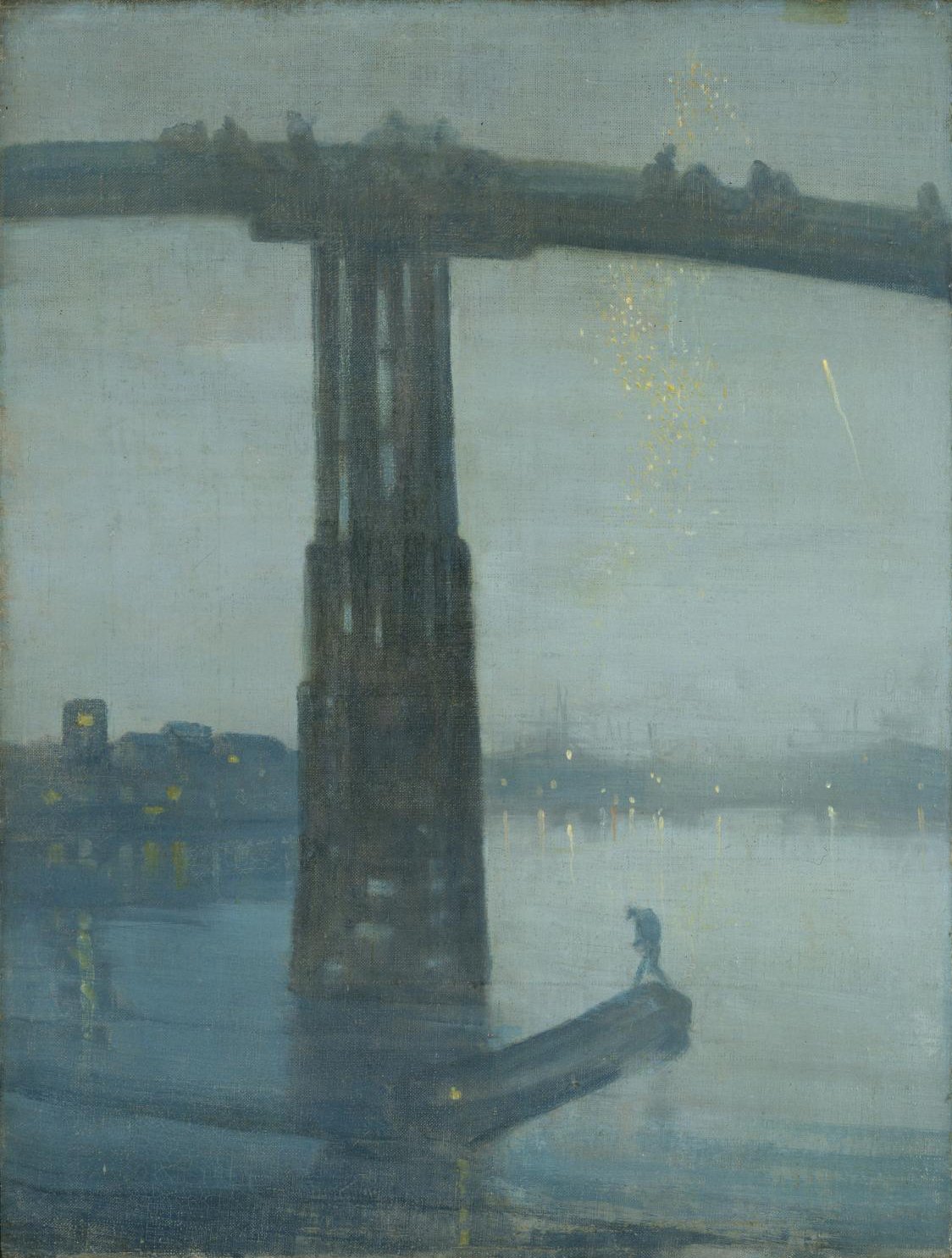
JM Whistler, Nocturne in Blue and Silver, Battersea Bridge, 1872-5
‘Is this part of the picture at the top Old Battersea-bridge?’ intoned the judge.
‘Your lordship is too close at present to the picture to perceive the effect which I intended to produce at a distance,’ replied the artist.
And were these people on the bridge? And was this a barge beneath it? Still Whistler retained his good temper. ‘The thing is intended simply as a representation of moonlight. My whole scheme was only to bring about a certain harmony of colour.’
Alongside the repeated questions about what was represented where in various pictures, the Attorney General made frequent reference to the price put by Whistler on the works, and the length of time it had taken to paint them. At one point the artist responded that the price reflected the lifetime of work that lay behind each picture – a remark that won him a loud round of applause. Any further outbursts, the judge warned, would result in him clearing the court. Excitement was reaching fever pitch, and then came the day’s piece de resistance: Nocturne in Black and Gold was brought in and shown to the jury.
‘This is Cremorne?’ asked the Attorney-General. It isn’t hard to imagine his tone.
‘It is a Nocturne in black and gold.’
‘How long did it take you to paint that?’
‘One whole day and part of another…’
‘What is the peculiar beauty of that picture?’
‘It would be impossible for me to explain to you, I’m afraid, although I dare say I could to a sympathetic ear.’
‘Do you not think Mr Ruskin might have come to the conclusion that it had no particular beauty?’ The Attorney-General was now well into his stride.
‘I think there is distinct evidence that he did…’
‘You offer that picture to the public as one of particular beauty, as a work of art, and which is fairly worth 200 guineas?’
‘I offer it as a work which I have conscientiously executed, and which I think worth the money. I would hold my reputation upon this as I would upon any of my other works.’
By this stage it ought to have been clear to Whistler’s counsel that the trial was not going well. They were supposed to be prosecuting Ruskin, but in the great man’s absence it was the wronged artist who was really on trial. In an age that worshipped work, here was a man who – as he freely admitted – charged a sum equivalent to around £20,000 today for ONE DAY’S LABOUR. And for a painting that in no way resembled the subject it claimed to depict.
The following morning Attorney General marched into the packed courtroom and attacked.
Imagine, he asked the jurors, that you are entering the Grosvenor Gallery. You will, of course, be attracted by Mr Whistler’s pictures, and you will possibly find some difficulty in approaching, from the fact of their being surrounded by beautiful ladies discussing the merits of the works before them…
Having thus gained the attention of the all-male jury, Sir John continued to elaborate on the scene. Baffled by the title, Nocturne in Blue and Silver, the imaginary ladies now examined the painting. ‘Then there was the structure. What was it? Was it a telescope or a fire escape, or the great tubular bridge? If Mr Whistler had wanted to make a picture why did he not make the bridge something like Battersea Bridge? Then, should they succeed in coming to the conclusion that the figures on the bridge were human beings, and horses and carts, they would naturally ask, “How in the name of fortune will they ever get off?”’ By now the hysteria was mounting again. The Attorney-General lowered his voice. ‘They must not speak up in the Grosvenor Gallery, lest they had an action brought against them.’
Turning to the Cremorne nocturne, Sir John suggested that Mr Whistler did not see things which other people saw; he heard artistic voices which others could not hear; and a rocket coming down in sparks was not a rocket to him, but represented some fantastic and mysterious forms which he depicted for the entrancement of the British public… There was at present, Sir John said, his expression no doubt becoming suddenly serious, a mania in literature, in art, and in philosophy to worship the incomprehensible, and to say of something which could not be understood, “It is exquisite.” So too in painting. But the mania was not one that should be encouraged, and this was certainly the view of Mr Ruskin.
In criticising Whistler, and standing firm against the aforementioned ‘mania’, Ruskin was doing the nation a service. Not only was he justified in his attack, but also in the language he used. What was a coxcomb, after all, but an old-fashioned licensed jester, who wore a cap with bells on his head with a cock’s comb on it, and told jokes from house to house? And if this was so, Whistler had nothing to complain about, since his pictures had afforded ‘a most amusing jest’. If Mr Whistler’s reputation as an artist was to be founded upon these pictures, he was a pretender to the accomplishment of painting which he did not possess, and was worthy of the name of coxcomb.
With this, Sir John brought on his first witness, one of the most celebrated and respected artists of the day: Edward Burne-Jones. He knew the artist well – had shown alongside him at the Grosvenor Gallery - and the transcripts of the trial suggest no malice in his testimony. Rather, he saw the pictures as the great majority of Parisian artists saw the work of Monet and the other Impressionists, from the perspective of a serious painter in the great tradition.
‘In your opinion,’ began Sir John, ‘what part do finish and completeness bear to the merit of a painting?’
‘I think complete finish ought to be the object of all artists.’
Sir John then showed him the Battersea Bridge nocturne, and asked whether he felt this painting had the finish of a complete work of art.
‘Not in any sense whatever. It is a beautiful sketch; but that is not alone sufficient to make it a good work of art. Form – quite as important as colour – is deficient in the picture.’
Then, following the by-now familiar pattern, the Cremorne nocturne was produced.
‘Is that picture, in your judgment, worth 200 guineas?’
‘No, I cannot say it is, seeing how much careful work men do for so much less.’
To prove the point, a portrait by Titian was then brought in for Burne Jones to study and, of course, compare with the Cremorne nocturne. Burne Jones examined the Titian. This was, in his opinion, a highly finished picture. This was the kind of work artists should aspire to. ‘We are none of us perfect,’ he added.
‘The danger is this, that if unfinished pictures become common we shall arrive at a stage of mere manufacture, and the art of the country will be degraded.’
And the value of this Titian, this exemplary work of art? A juror asked the question. ‘Is it worth a thousand pounds?’ This from Whistler’s counsel.
‘It would be worth many thousands to me,’ said Burne Jones, ‘but it might be sold for forty pounds.’
Forty pounds for a Titian? Two hundred guineas for a Whistler nocturne? And now here on the stand was William Frith RA, a painter whose willingness to embrace the work ethic of the day could literally be measured by the scale and complexity of paintings like The Railway Station and The Derby Day – colossal depictions of crowded scenes in which every individual person is drawn in loving detail. He had initially refused to testify against a ‘brother artist’ and was in court under sub poena, but he wasted no time in avowing that the nocturnes were not serious works of art.
‘Are composition and detail important elements in the merit of a picture?’ counsel for the defence asked.
‘Very,’ he replied – not unsurprisingly – ‘and without them a picture cannot be called a work of art.’
Belatedly leaping into action, Serjeant Parry seized on this remark, asking Frith if he had read Ruskin’s works. He had, or claimed to have done.
‘We know that Turner is an idol of Mr Ruskin?’
‘I think he should be an idol of all painters,’ responded Frith.
‘Have you seen Turner’s picture of the snow storm?’
‘Yes.’
Do you know that a critic described that picture as “a mass of soap-suds and whitewash”?’
The crowd loved this, giving Serjeant Parry his first big laugh of the trial, but Frith went one better.
‘Yes, and I think it very likely that I should call it so myself! (cue laughter) When I say that Turner should be the idol of painters I refer to his earlier works, and not to the period when he was half crazy and produced works about as insane as the people who admire them (more laughs). I have heard Turner himself speak of some of his productions as nothing better than salad and mustard!’
With that the fun was nearly over. In summing up, the judge instructed the jury to find for the plaintiff if they saw no justification for Ruskin’s personal and humiliating attack on Whistler, and this they duly did. But in awarding token damages of a farthing the jury signalled that the case should never have been brought to trial, and in this the judge concurred, refusing to award costs. So Whistler won in one sense – Ruskin’s resignation from the Slade Professorship soon followed – but lost in another, being bankrupted by the court costs.
Over century and a half that followed ‘unfinished pictures’ did indeed become common, and now Whistler has an exhibition at Tate Britain (an institution that first opened its doors in 1897). So in the end he was vindicated - or is for now!
James McNeill Whistler is at Tate Britain until 27 Sept 2026